Contents
Spreadsheets are ubiquitous in business environments, particularly in small to medium-sized enterprises. Their flexibility, low cost, and familiarity make them an attractive option for many internal processes — including training management. However, as organisations grow and compliance demands tighten, the limitations and risks of spreadsheets become starkly apparent.
When it comes to managing a workforce’s training requirements, spreadsheet-based approaches can no longer meet the needs of accuracy, scalability, or auditability. This whitepaper explores the growing body of evidence showing that spreadsheets are inadequate for managing training data and illustrates why purpose-built training matrix software delivers superior results across every metric.
The Hidden Risks of Spreadsheets
Error Rates Are Alarmingly High
Despite their popularity, spreadsheets are notoriously prone to error. A seminal study by Raymond R. Panko at the University of Hawaii found that 94% of spreadsheets contain errors, with an estimated 5.2% of formula cells incorrect. These aren’t typos — they can be the difference between a compliant workforce and a failed audit.
MarketWatch estimates that 88% of all spreadsheets contain human input errors, which can result in misreported qualifications, expired certifications, or non-compliance with regulatory frameworks. In safety-critical industries like construction, logistics, and healthcare, this kind of oversight can be devastating.
A notable example is the Crypto.com incident, where a $10.5 million refund was made instead of $100 due to a spreadsheet mistake. Although not related to training data, it’s a stark reminder that spreadsheet errors can have far-reaching consequences.
Lack of Accountability and Version Control
Spreadsheets are not inherently designed for collaboration, security, or audit trails. In many organisations, different departments use slightly different versions of the same spreadsheet — leading to inconsistent data and miscommunication.
Without proper version control, it’s difficult to verify who changed what and when. If an auditor or regulator requests documentation, there may be no way to prove compliance reliably.
The European Spreadsheet Risks Interest Group (EuSpRIG) has catalogued hundreds of spreadsheet-related failures and classifies spreadsheet risk as a corporate governance issue in regulated industries. Their research makes it clear: spreadsheets are a liability when used for business-critical functions.
Inefficiency and Scalability Issues
Wasted Time and Manual Workarounds
Training managers often spend hours manually checking training expiry dates, sending reminders, updating records, and generating reports. This isn’t just inefficient — it’s demoralising and unsustainable.
A Deloitte study found that businesses spend up to 30% of their operational time managing fragmented data sources like spreadsheets. Time that could be spent improving workforce skills is instead spent fighting formatting, cross-referencing rows, and resolving access conflicts.
Growth Amplifies the Problem
As organisations grow, spreadsheet complexity compounds. A training matrix that worked for 15 employees quickly becomes unmanageable at 50, let alone 500.
Key limitations include:
- No automated alerts for expiring qualifications
- Difficult to visualise team-wide compliance
- Inconsistent data entry formats
- No secure role-based access
This leads to increasing risk exposure as team size and compliance complexity grow. While the spreadsheet might feel like a familiar friend, it becomes a bottleneck to progress.
How Training Matrix Software Solves the Problem
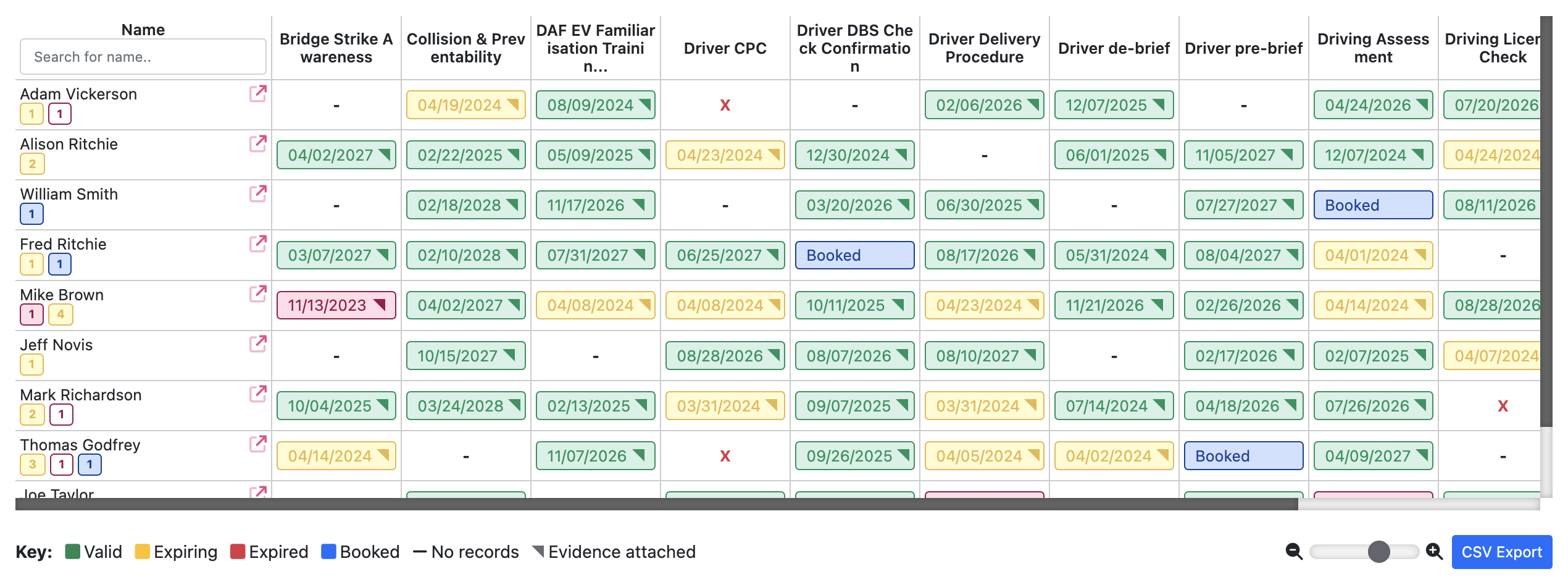
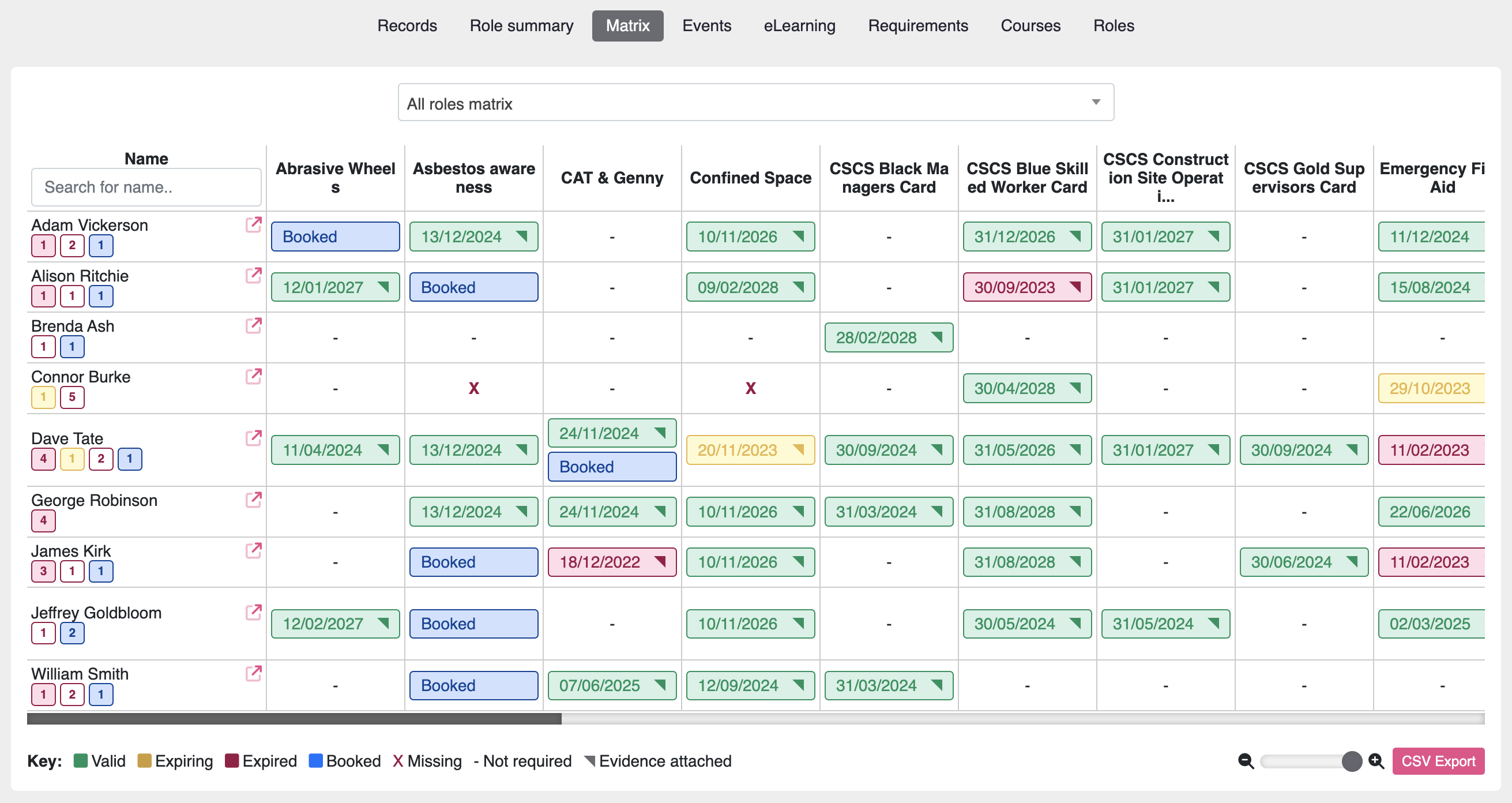
Training matrix software such as Moralbox is designed specifically to overcome these challenges. It transforms a reactive, manual process into a streamlined, intelligent workflow.
Core Benefits
- Automated Reminders: The system notifies staff and managers before training expires, reducing missed renewals.
- Real-Time Dashboards: Get instant visibility into who’s compliant and who needs training — by role, department, or site.
- Audit-Ready Records: Generate downloadable reports with full history and timestamps.
- Role-Based Access Control: Grant appropriate access to training data while maintaining compliance with GDPR and ISO 27001 principles.
- Historical Tracking: Easily view past training, gaps, and corrective actions.
- Predictive Capabilities: Identify emerging skills gaps using trends and analytics.
Software Designed to Grow with You
Modern platforms are cloud-based, accessible from anywhere, and integrate with HR systems. Moralbox, for example, automatically updates your training matrix based on employee roles and allows remote training records to be uploaded instantly — something a spreadsheet will never do.
Industry Impact and Case Studies
Organisations that make the switch from spreadsheets to training matrix software often see rapid improvements.
In one case, a UK-based construction firm using Moralbox reported the following within three months:
- 60% reduction in admin hours spent managing training
- 90% drop in expired qualifications
- Full compliance during their external ISO 45001 audit, with zero corrective actions required
A logistics company operating across 10 UK depots moved their spreadsheet system into Moralbox and achieved:
- Unified visibility across all locations
- Streamlined onboarding with automated training allocation
- Faster reporting for B2B client audits
Regulatory and Legal Considerations
Training compliance isn’t optional — especially in regulated industries. Failure to prove workforce competence can lead to:
- Fines and sanctions from regulatory bodies (e.g., HSE, CQC)
- Contract losses due to failed client audits
- Increased insurance premiums
- Harm to brand reputation following a health and safety incident
Using spreadsheets increases the chance of non-compliance. Dedicated training software mitigates this risk by ensuring records are accurate, accessible, and backed by digital audit trails.
Conclusion
Spreadsheets have their place — but managing training compliance isn’t one of them. From widespread error rates to data governance risks, they are no longer fit for purpose in a modern business environment.
Training matrix software is built to centralise, automate, and future-proof your training and compliance efforts. It reduces admin, minimises risk, and gives your organisation the confidence to scale safely and compliantly.
Is your business still relying on spreadsheets to manage training?
If so, now is the time to evolve.
👉 Learn more about what a training matrix is and how it works.
Citations & References:
Deloitte – “Data Management Insights” (https://www2.deloitte.com)
Raymond R. Panko – “What We Know About Spreadsheet Errors” (https://panko.com/ssr/)
The Guardian – “Crypto.com Error” (https://www.theguardian.com/technology/2022/aug/30/crypto-exchange-accidentally-refunds-woman-10m-instead-of-100)
MarketWatch – Spreadsheet Human Error Rates
EuSpRIG – Spreadsheet Risk Reports (https://www.eusprig.org/)