The UK continues to face a scale of workplace harm that should trouble any business leader. The latest data shows that, despite decades of regulation, organisations continue to injure workers, drive stress-related harm and leave employees with chronic health conditions. Ultimately, these outcomes are not random. Crucially, they follow patterns that point to deeper organisational limitations. In practice, UK workplace training gaps rarely appear overnight; rather, they emerge as organisations fail to manage and maintain competence actively.
Across multiple sectors, incidents occur not because organisations neglect training entirely, but because UK workplace training gaps persist when leaders fail to maintain competence, refresh knowledge, verify capability and manage modern risks.
To understand why this continues to happen, we need to examine the latest evidence.
TABLE OF CONTENTS
- What the Latest UK Statistics Reveal
- Recent Incident Narratives: What They Reveal About Competence Failures
- Training Gaps Are Symptoms, Not Causes
- The Organisational Cost of These Failures
- What Organisations Must Do Differently
- How Moralbox Would Have Changed the Underlying Conditions Behind These Incidents
- Conclusion: The True Culprit Is Complacency
- FAQs
- References
What the Latest UK Workplace Statistics Reveal
The Health and Safety Executive’s 2024–25 figures present a workforce under sustained and predictable pressure. According to the HSE, 1.9 million workers suffered from work-related illness during the period (HSE 2025a). Of these, 964,000 experienced work-related stress, depression or anxiety, while 511,000 reported musculoskeletal disorders (HSE 2025a). Taken together, these two categories continue to dominate modern workplace harm.
Injury remains widespread. Around 604,000 workers sustained a non-fatal injury, primarily due to slips, trips, falls, manual handling and contact with moving objects (HSE 2025a). Although fatal injuries have declined dramatically over the decades, the figures remain sobering. In 2023/24, there were 138 worker fatalities, while provisional data for 2024/25 record 124 deaths (HSE 2025a; HSE 2024).
Furthermore, the economic impact is enormous. Work-related injury and ill health now cost the UK £22.9 billion, with long-term sickness and stress-related absence making up the bulk of this burden (HSE 2025a). The country lost 40.1 million working days, most of them attributable to stress and musculoskeletal conditions (HSE 2025a).
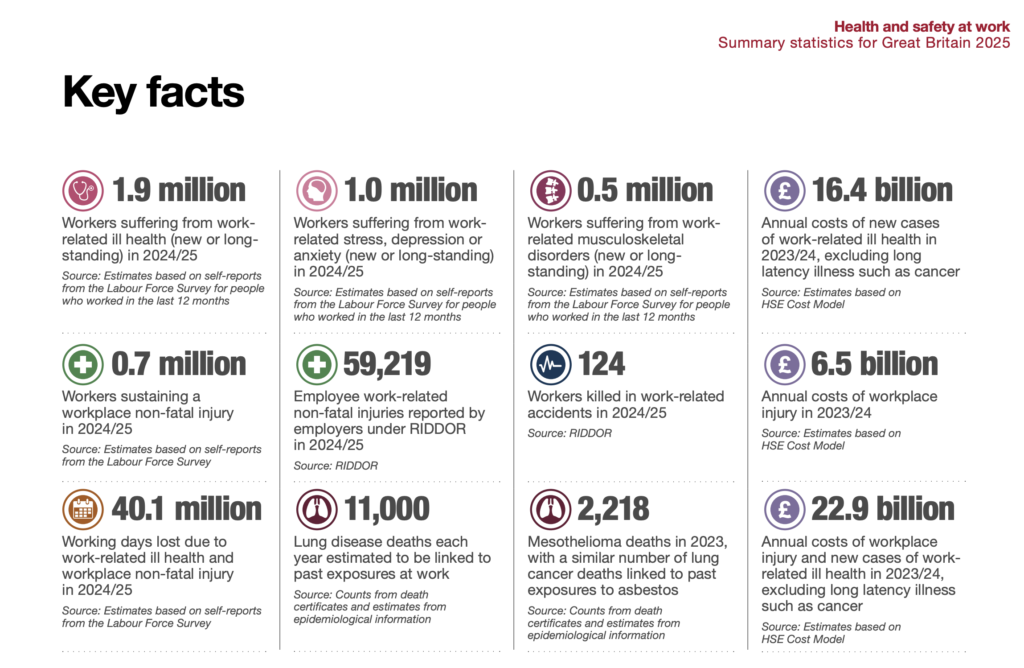
Source: HSE 2024-25 Workplace Health and Safety at Work Statistics, Health and Safety Executive (HSE, 2025a)
Independent commentary reinforces the trend. HCS Safety’s review of the 2024/25 data highlights the persistent rise of stress-related illness. It warns that organisations continue to overlook psychosocial risk management, despite its increasing prominence in enforcement guidance (HCS Safety 2025). Similarly, LiveCareer’s 2025 analysis highlights the same challenge, noting that workplace stress is now prevalent across industries, driven by workload pressure, organisational change, poor support structures and unclear expectations (LiveCareer 2025).
Thus, this convergence of evidence suggests a systemic, not incidental, failure. Viewed through this lens, UK workplace training gaps consistently drive both physical injury and work-related ill health, rather than appearing as isolated issues.
👉 Suggested reading: What Is the Biggest Cause of Workplace Injury and How SMEs Can Stay Ahead of Claims.
Explores the most common causes of workplace injury in the UK and explains how smaller organisations can proactively reduce incidents and compensation claims.
Recent UK Workplace Incidents and Competence Failures
The statistics describe scale, but individual incidents reveal root causes. The following anonymised scenarios, consistent with patterns in HSE case material, illustrate how training gaps emerge from organisational assumptions rather than a lack of intent.
1. Manual Handling Injury and Workplace Training Failure
A logistics firm experienced a severe back injury incident when an employee attempted to lift excess weight alone. Although the worker had received manual handling training three years earlier, the organisation had not implemented refreshers, competence checks or supervision to reinforce safe technique.
Consequently, the incident illustrates how quickly capability deteriorates without structured reinforcement, and how an organisation’s confidence in “completed training” often masks competence that has quietly decayed.
2. Stress-Related Breakdown and Psychosocial Risk Management
Months of unmanageable workload increases pushed a skilled administrator into long-term stress-related absence. Their line manager lacked training in psychosocial hazard recognition, failed to conduct a stress risk assessment and missed clear signs of deteriorating well-being.
As a result, this reflects a wider pattern: psychosocial risk management is a legal requirement, yet remains inconsistently understood or prioritised. HSE’s data confirms that stress, depression and anxiety now represent the UK’s most common work-related illness category (HSE 2025a; LiveCareer 2025), making these omissions far from trivial.
3. The Temporary Worker Machinery Near-Miss
A temporary worker narrowly avoided a crush injury after moving close to machinery requiring specialist training. Although they completed a general induction, they were never provided with the task-specific instruction necessary for that environment. The employer lacked a structured competence management system and assumed induction equalled readiness.
This case illustrates the dangers of relying on generic onboarding without validating the precise competencies required for each role, particularly when it comes to temporary or agency workers.
| Risk Area | Common Failure | Why It Matters |
|---|---|---|
| Competence maintenance | Training completed years ago with no refreshers | Skills decay → unsafe behaviour |
| Role-specific training | Generic induction only | High-risk tasks are assigned incorrectly |
| Manager capability | Training not matched to the hazard | Stress escalates unnoticed |
| Tracking systems | Spreadsheets or manual logs | Blind spots, expiries, inconsistency |
| Temporary labour | No structured onboarding | High-risk tasks assigned incorrectly |
Taken together, these incidents expose a single underlying truth: organisations rarely cause harm by omitting training altogether. Instead, harm emerges when organisations fail to build systems that sustain competence, align training with task risk and maintain visibility over workforce readiness.
UK Workplace Training Gaps Are Symptoms, Not Causes
Many organisations consider themselves “training compliant”, yet incidents continue to occur at scale. That contradiction is easily explained once one examines the mechanics of how competence is managed.
1. Competence Is Treated as Static
Skills deteriorate, habits erode, and circumstances change. Without structured refresher cycles, training loses operational value. HSE guidance repeatedly emphasises that competence must be maintained, not merely acquired (HSE 2025b).
2. Training Is Often Generic Rather Than Role-Based
General inductions cannot substitute for task-specific competence. Consequently, organisations that standardise training without aligning it to operational risk inevitably create blind spots.
3. Psychosocial Risks Are Still Poorly Understood
With nearly one million workers suffering stress-related conditions (HSE 2025a), psychosocial risk is now a dominant threat. Yet, many managers lack training in recognising or mitigating it, as echoed in both HCS Safety’s review and LiveCareer’s analysis (HCS Safety, 2025; LiveCareer, 2025).
4. Organisations Lack Feedback Loops
Training is often evaluated in terms of attendance rather than behavioural change. Without observation, auditing and follow-up, unsafe practices return rapidly.
5. Competence Tracking Systems Are Fragmented or Manual
Spreadsheets, disjointed documents and siloed systems lead to missed renewals, inconsistent onboarding and an inability to prove compliance during investigations. These weaknesses are repeatedly noted in enforcement cases.
The implication is clear: organisations are not failing because workers are untrainable, but because their frameworks for managing risk and maintaining competence are outdated.
The Organisational Cost of These Failures
Beyond the obvious human impact, organisations bear high long-term costs. In fact, these failures carry consequences that extend well beyond individual incidents. Over time, UK workplace training gaps translate into measurable financial, operational and reputational damage for employers.
- escalating sickness absence
- reduced productivity
- higher insurance premiums
- operational disruption
- reputational harm
- declining morale and retention
The £22.9 billion national cost estimate (HSE 2025a) is not abstract. Rather, it reflects thousands of individual organisations absorbing preventable losses.
What Organisations Must Do Differently
If the UK is to reverse the current trends, competence management needs to become a live process rather than an annual tick-box exercise.
1. Treat Competence as Continuous
Automated renewals, periodic assessments and observational checks should be standard.
2. Deliver Task-Specific Training, Not Generic Modules
Workers must be trained for the hazards inherent in their specific tasks, not merely their job titles.
3. Equip Managers to Manage Psychosocial Hazards
This requires structured training in stress identification, workload planning and meaningful wellbeing conversations. Crucially, it directly addresses the highest-volume category of illness.
4. Integrate Review and Feedback Mechanisms
After any incident or near miss, organisations should review competence, systems and behaviour—not simply offer another session of generic training.
👉 Suggested reading: Why Corporate Training Fails: The Hidden Gaps Between Compliance and Competence
Explores why training programmes often look compliant on paper but fail to translate into safer behaviour, sustained competence and real risk reduction.
How Moralbox Would Have Changed the Underlying Conditions Behind These Incidents
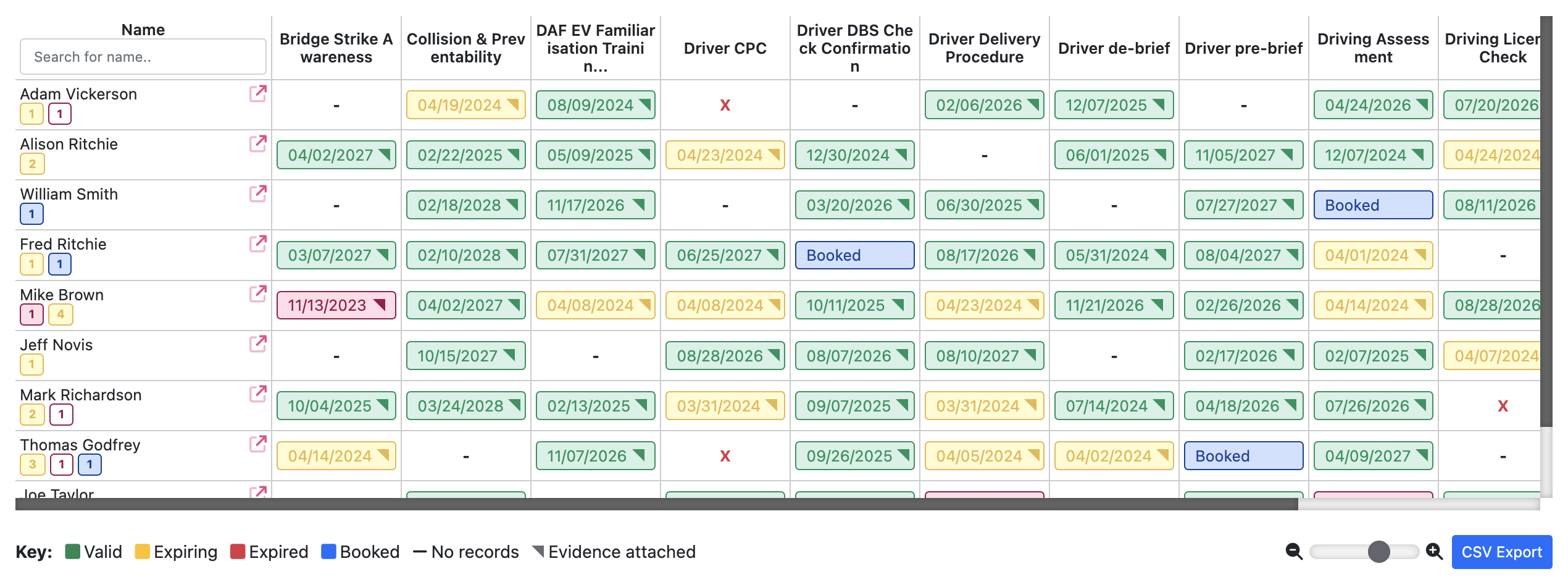
The incidents described earlier share a common theme: decisions were made without accurate, real-time visibility into competence. Training had expired unnoticed, task-specific requirements were unclear, and managers lacked structured processes to monitor employee well-being or validate their capabilities. In essence, these are system failures, not people failures, and they are exactly the gaps Moralbox is designed to close.
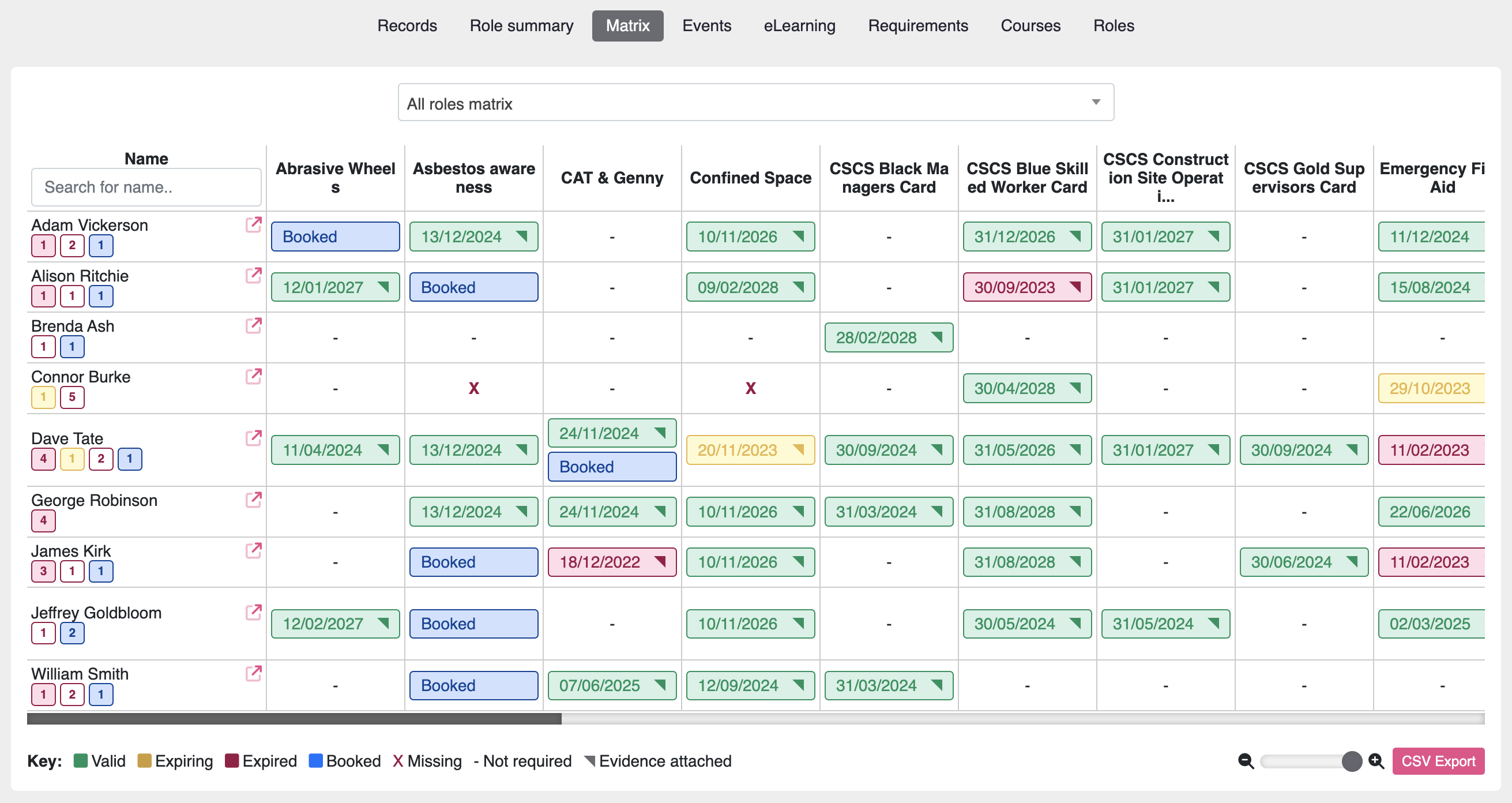
A platform like Moralbox strengthens organisational control by ensuring competence is not assumed but continuously verified. It aligns every role with its required training, highlights gaps before they become risks, and gives managers a clear, evidence-based view of who is safe and ready to work. Temporary staff are onboarded consistently rather than informally. Supervisors receive early signals when training is due, when documentation is missing, or when workloads and well-being indicators suggest escalation risk. Leadership gains the assurance that the workforce is not only certified but demonstrably competent.
Instead of relying on spreadsheets or memory, the organisation operates with structured renewal cycles, documented proof of competence, and transparent accountability. Ultimately, this is the operational shift that prevents the quiet drift into unsafe patterns that most incidents reveal only after harm has occurred.
Where Moralbox Makes the Difference
- Visibility: managers see competence gaps before they surface as incidents.
- Consistency: new and temporary workers receive the right training, not generic induction.
- Verification: competence is evidenced, not assumed.
- Assurance: leadership retains an auditable chain of compliance and risk insight.
Collectively, these aren’t mere features; they are the conditions for a safer, more predictable workplace. Moralbox simply gives organisations the infrastructure to maintain them.
These capabilities map precisely to the weaknesses highlighted by HSE data and the incident narratives above.
Conclusion: The True Culprit Is Complacency
UK workplace training gaps do not appear by accident. They emerge when organisations assume compliance equals safety, when competence is taken for granted and when modern risks are dismissed as peripheral.
The evidence shows that many UK workplaces rely on outdated systems that fail to sustain competence in an environment where physical and psychosocial hazards are constantly evolving.
If organisations shift from sporadic training to continuous, data-driven competence management, the outcomes will be immediate: fewer incidents, a healthier workforce, lower costs and a culture that protects rather than reacts.
The tools exist. The data is clear. The obligation is overdue.
FAQs
1. What causes most workplace incidents in the UK?
In most cases, workplace incidents stem from outdated training, missed refresher courses, poor competence tracking, inadequate supervision, and a lack of role-specific instruction. Additionally, stress, manual handling errors and slips or trips remain among the top contributors. Altogether, these factors demonstrate how easily risk escalates when organisations rely on assumptions rather than verified competence.
2. How can companies spot training gaps early?
Companies can identify gaps by first comparing required skills against actual competence, and then monitoring expiring training and overdue refreshers. Furthermore, reviewing near-miss data helps reveal behavioural or procedural weaknesses. Finally, using a digital training matrix that highlights gaps in real time gives organisations proactive visibility rather than reactive insight.
3. What tools help reduce training-related incidents?
Competence platforms that automate training matrices, track certifications, issue expiry alerts and store evidence of training help organisations ensure the right people are qualified for the right tasks.
References
Health and Safety Executive (2025a) Key figures for Great Britain 2024 to 2025. Available at: https://www.hse.gov.uk/statistics/overview.htm.
Health and Safety Executive (2025b) Health and safety at work: Summary statistics for Great Britain 2025. Available at: https://www.hse.gov.uk/statistics/assets/docs/hssh2425.pdf.
Health and Safety Executive (2024) Health and Safety statistics: 2023 to 2024 annual release. Available at: https://www.gov.uk/government/statistics/health-and-safety-statistics-2023-to-2024-annual-release.
HCS Safety (2025) What the 2024/25 HSE statistics tell us about the state of UK workplace health. Available at: https://hcssafety.co.uk/news/2025-hse-statistics-tell-us/.
LiveCareer UK (2025) Work-related stress in the UK: statistics for 2025. Available at: https://www.livecareer.co.uk/career-advice/work-related-stress.

Ananya is a Marketing Executive at Moralbox, passionate about creating content that connects learning with business impact.