Introduction
Training completion rates are high in most organisations. Employees click through modules, pass end-of-course quizzes and appear fully compliant in the LMS. Yet when real decisions need to be made, critical steps are often forgotten, mistakes are repeated, and procedures break down. The training may be “completed”, but the learning has not had enough reinforcement to influence behaviour.
This happens with a simple scientific reason of why corporate training fails: memory decays rapidly when information is delivered once and never revisited. In fact, classic evidence summarised by Carpenter et al (2022) shows that after one week, learners who re-read the material scored around 53%, while those who practised retrieval scored 87%. The gap between these two outcomes is the gap between traditional training and evidence-based learning design.
Consequently, organisations frequently invest in awareness rather than capability. As training budgets grow, the absence of reinforcement, retrieval and real-world application silently erodes the impact.
To demonstrate how this unfolds in real settings, consider the following scenario.
TABLE OF CONTENTS
- Introduction
- A micro-case: when learning does not reach the job
- Why corporate training fails
- The science of retention: four principles organisations must use
- The R.A.P.I.D. retention framework
- How technology fixes the retention problem
- Closing the Gap Between Training and Real Competence
- Conclusion: retention determines impact
- FAQs
- References
A micro-case: when learning does not reach the job
Before examining the broader causes of poor retention, it helps to observe how quickly training breaks down in a real operational context. This example illustrates how compliance on paper can conceal fragile learning beneath the surface. It also shows why organisations often misjudge whether a workforce is truly competent or simply recently exposed to information.
For example, A national utilities company trains 600 field engineers in a mandatory 2-hour safety session. Completion is 100% and the average end-of-course quiz is 86%. Hence, Compliance appears strong.
Six weeks later, supervisors notice repeating errors in field audits. Many engineers cannot recall the correct order of lockout-tagout steps without prompts. Although the training is documented and certificates are on file, the knowledge is not accessible in memory when needed.
This is not a failure of employees but a failure of the training design. Knowledge was delivered, but it was never reinforced, retrieved or applied. As a result, it faded.
This scenario is common across sectors. However, to understand why, we must examine the predictable reasons training fails to stick.
Why corporate training fails
Training decay is not random. It follows clear cognitive patterns that have been documented for decades. Before designing solutions, organisations must recognise which elements of their current approach actively force forgetting. The following seven failure points consistently appear in corporate environments, explaining why training rarely has a lasting impact on influencing performance.
Training is too passive
Slide decks, explained modules, and passive presentations create shallow encoding. Learners absorb information but do not process it deeply. Endres et al. (2024) found that constructive recovery, where learners generate examples and explanations, significantly outperforms passive study in both comprehension and later recall.
Training is treated as a one-off event
One-time exposure is insufficient for durable memory. Spacing is essential. Without opportunities to revisit content, forgetting accelerates (Carpenter et al., 2022). Annual refreshers cannot compensate for eleven months of unreinforced decay.
There is little or no retrieval practice
Retrieval practice is one of the most powerful learning mechanisms. Each recall attempt strengthens memory traces. Carpenter, Pan and Butler (2022) highlight that retrieval drastically improves long-term retention compared with re-reading, yet most organisations test knowledge only once.
Cognitive overload disrupts encoding
Employees often face dense, overloaded training sessions. Working memory cannot process excessive information at once. Twabu (2025) shows that cognitive overload in digital learning environments compromises encoding quality and results in weaker retention.
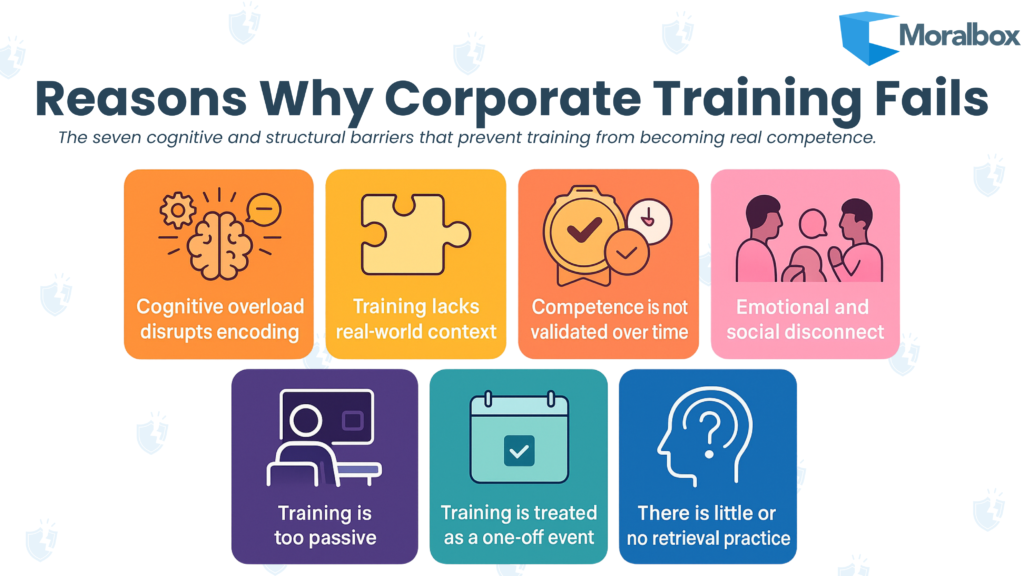
Training lacks real-world context
Abstract instruction does not easily transfer into real practice. Learners need realistic scenarios, decisions and contextual cues. Without these, retention may appear adequate, but the application fails.
Competence is not validated over time
Completion records show attendance, not ability. Skills decay unless tested over a period of time. Organisations that rely on one-off certification cannot see when capability breaks down until incidents surface.
Emotional and social disconnect
People retain information more effectively when it is meaningful, emotionally engaging or reinforced socially. Collaborative explanation and active generation improve retention and metacognitive accuracy (Endres et al., 2024). Isolated e-learning rarely achieves this.
Therefore, these seven failure points explain why training often produces certificates but not competence.
👉 Suggested Reading: For a concise overview of how the brain actually processes and retains information, explore our Cognitive Learning Theories guide. It adds scientific context to why training succeeds or fails.
The science of retention: four principles organisations must use
Identifying what goes wrong and why corporate training fails is only half the task. The next step is understanding the scientific mechanisms that actually support long-term retention. Cognitive psychology offers clear, proven principles that shape how memory forms, strengthens and persists. The four evidence-backed mechanisms below represent the foundation of any effective learning strategy.
Spacing enables consolidation
Spacing learning across multiple encounters improves long-term retention far more than massed exposure (Carpenter et al., 2022).
Retrieval strengthens memory
Retrieval is a learning event, not merely an assessment. Classic studies summarised by Carpenter et al. (2022) show that retrieval practice produces dramatically superior long-term retention than re-reading.
Managing cognitive load improves encoding
Working memory must not be overwhelmed. Twabu (2025) demonstrates that reducing extraneous cognitive load improves learners’ ability to encode and later recall information effectively.
Context and application support transfer
Retention is not enough. Learners must recognise when and how to use the knowledge. Scenario-based decisions, simulations and real-world practice deepen encoding and support transfer.
These principles clearly indicate that training must be designed as a retention system, not a one-time delivery event.
To help organisations apply these principles, we now turn to a practical framework.
The R.A.P.I.D. retention framework
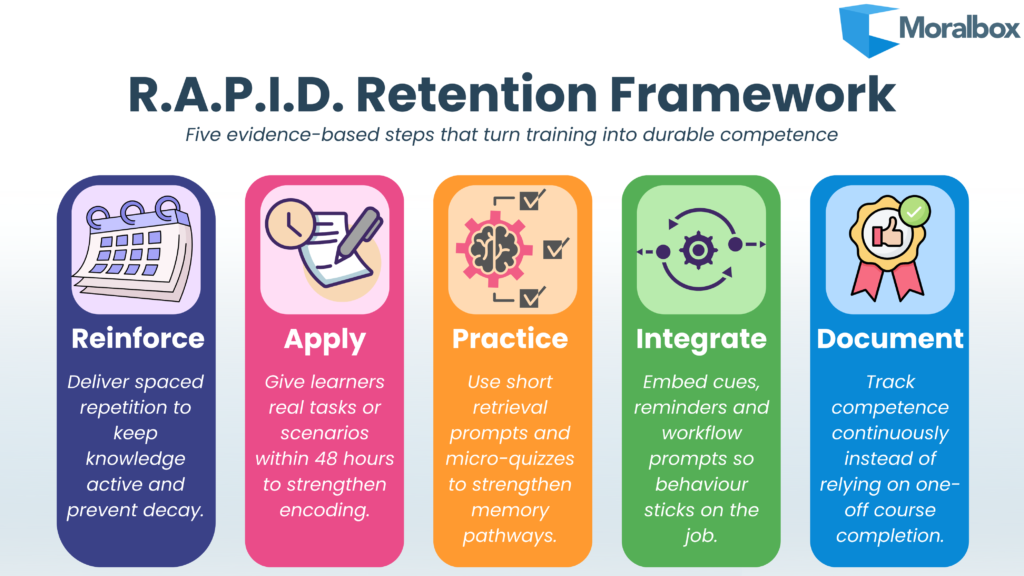
To convert research into practice, organisations need a framework that translates cognitive principles into actionable design. R.A.P.I.D. serves as a practical blueprint for shaping learning experiences that stick, making sure that reinforcement, application and competence measurement are built into the learning cycle rather than added as afterthoughts.
R – Reinforce
Use spaced repetition to reinforce knowledge across weeks and months.
A – Apply
Create opportunities to use new skills within 48 hours. This strengthens encoding and builds relevance.
P – Practise
Embed retrieval through micro-quizzes, scenario questions and reflective prompts.
I – Integrate
Add cues, checklists and workflow prompts so the environment reinforces the behaviour.
D – Document
Track competence, not just course completion. Maintain evidence that skills remain current.
R.A.P.I.D. is simple but grounded in strong empirical findings. The next challenge is operationalising it at scale.
👉 Suggested Reading: To strengthen your retention strategy with accurate skill validation, see our Competency-Based Assessment guide. It shows how to measure competence rather than completion.
How technology fixes the retention problem
Once the principles are clear, the practical challenge emerges: retention cannot be sustained manually. Large workforces need consistent reminders, recurring assessments, contextual cues and reliable competence data. Technology is what allows these evidence-based mechanisms to run continuously and accurately across an organisation.
Reinforce– Automated spacing sequences deliver refreshers at appropriate intervals.
Apply: Digital simulations and workflow-triggered activities encourage real-world practice.
Practice: Short, regular retrieval prompts strengthen memory and reveal early gaps.
Integrate: In-work nudges, reminders and checklists support consistent behaviour.
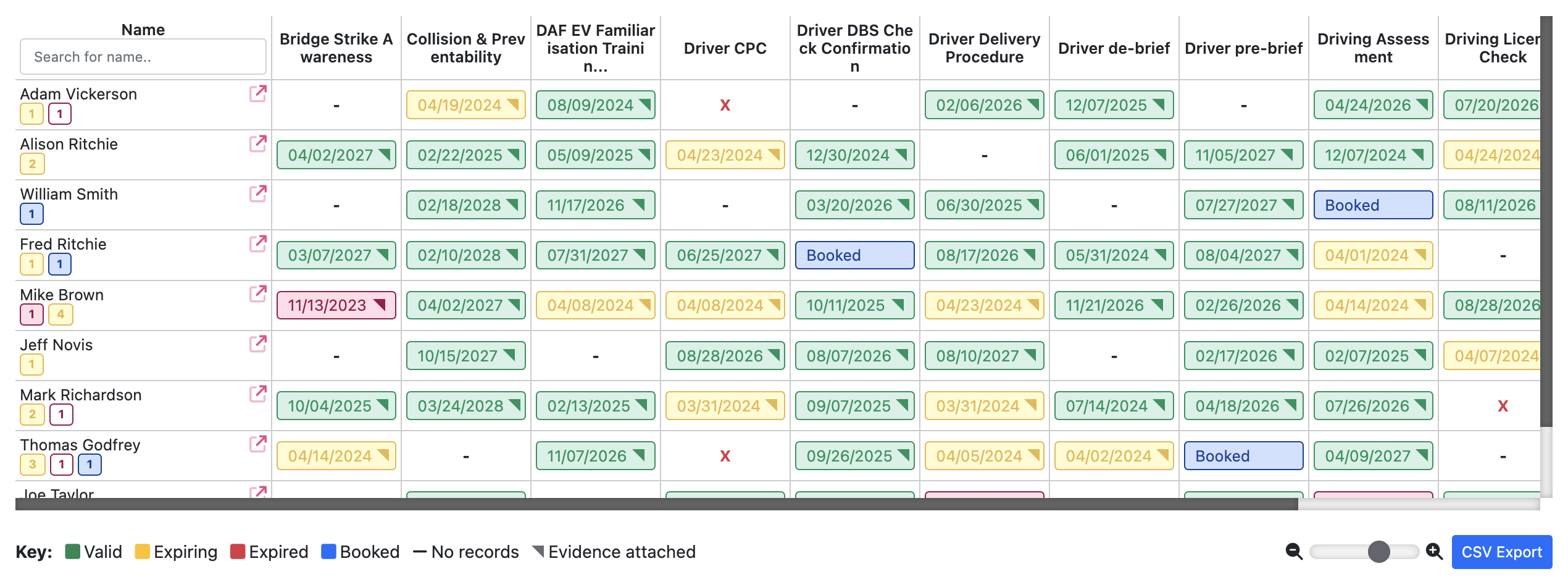
Document: Competence dashboards highlight who is capable, who is at risk and where interventions are needed.
With the right technology, retention ceases to depend on hope and becomes an engineered system. Thus, helps to fix why corporate training fails.
Closing the Gap Between Training and Real Competence
Once organisations accept that retention depends on reinforcement, retrieval, relevance, integration and ongoing competence evidence, the practical question becomes how to operationalise these principles across a real workforce. Doing this manually is unrealistic, particularly when teams are large, roles vary widely, and skills expire at different intervals. This is where a retention-first platform becomes valuable, because it can automate the mechanisms that learning science depends on.
A well-designed system can reinforce learning by automatically resurfacing critical knowledge at spaced intervals, ensuring employees revisit content before it fades. It can also strengthen the application by mapping training to the specific competencies each role demands, making learning more relevant and directly tied to day-to-day work. It can support practice through short, recurring micro-checks that prompt learners to retrieve key concepts, helping to maintain memory and expose early knowledge gaps. Moreover, it can integrate learning into the workflow through alerts, dashboards and manager visibility, so that behaviour is reinforced rather than left to chance. Crucially, it can also document competence over time by capturing sign-offs, assessments and evidence of skill, providing leaders a clear, real-time view of capability and emerging risk.
This is precisely the infrastructure that Moralbox provides. By automating reinforcement cycles, linking training to role-specific competencies, including retrieval practice, and offering live visibility of workforce capability, Moralbox helps organisations shift from “training completed” to verified competence.
If you want to see how a retention-first approach works in your organisation, you can book a Free Discovery Call with experts to explore what this would look like in practice.
Conclusion
Corporate training does not fail because employees don’t want to learn. It fails because learning is not reinforced, practised or contextualised. Modern research shows that long-term retention is influenced by spacing, retrieval, cognitive load management and relevant application.
Organisations that commit to retention-first learning see clearer performance improvements, reduced risk and higher return on training investment. With the support of modern platforms such as Moralbox, building a retention system is not only possible but straightforward.
If your organisation wants training that actually transfers into practice, the solution begins by designing for retention.
FAQs
Why do employees forget training so quickly?
Because memory requires reinforcement. Without spacing and retrieval, learners tend to forget a large portion of new information within days. Classic studies summarised by Carpenter et al. (2022) illustrate this clearly.
What is the most effective way to improve retention?
Retrieval practice combined with spaced reinforcement. These mechanisms consistently deliver superior long-term retention (Carpenter et al., 2022; Endres et al., 2024).
How does Moralbox support retention?
Moralbox automates reinforcement cycles, integrates micro-assessment, validates competence and provides real-time visibility of emerging skills gaps, which supports long-term retention.
References
Carpenter, S.K., Pan, S.C. and Butler, A.C. (2022) ‘The science of effective learning with spacing and retrieval practice’, Nature Reviews Psychology, 1(9), pp. 496–511. Available at: https://doi.org/10.1038/s44159-022-00089-1.
Endres, T., Carpenter, S. and Renkl, A. (2024) ‘Constructive retrieval: Benefits for learning, motivation, and metacognitive monitoring’, Learning and Instruction, 94, p. 101974. Available at: https://doi.org/10.1016/j.learninstruc.2024.101974.
Twabu, K. (2025) ‘Enhancing the cognitive load theory and multimedia learning framework with AI insight’, Discover Education, 4(1). Available at: https://doi.org/10.1007/s44217-025-00592-6.

Ananya is a Marketing Executive at Moralbox, passionate about creating content that connects learning with business impact.