Why Audit Surprises Happen in the First Place
A comprehensive training needs analysis for compliance can help prevent audits from failing. Audits rarely fail due to a single dramatic oversight. They fail because of accumulated small gaps that go unnoticed until the external review begins. On the morning of an audit, those gaps suddenly become visible. The auditor may ask who holds the authorisation to perform a task, where the organisation keeps their competence evidence and how managers ensure they have not missed anyone. Many companies assume they can answer confidently, then realise their training records sit scattered across spreadsheets, emails and old files.
More often than not, the root cause is not the audit itself. It is the absence of a structured, risk-based Training Needs Analysis (TNA) that links roles, regulatory obligations, tasks, training and true evidence of competence. Without that link, teams manage training reactively, inconsistently and with little control, and the moment an audit arrives, the organisation exposes itself to avoidable gaps.
In this article, we reframe Training Needs Analysis not as an HR development exercise but as a critical compliance control. In regulated and safety-sensitive environments, TNA must prevent audit surprises rather than respond to them. The rest of this guide demonstrates how recent evidence supports this view and how a systematic, technology-enabled TNA becomes essential for audit readiness.
TABLE OF CONTENTS
- Why Audit Surprises Happen in the First Place
- Why TNA Means Something Different in Regulated Environments
- What Auditors Expect and Where Many Organisations Still Fall Short
- What Recent Research in High-Risk Sectors Reveals About TNA
- The True Cost of an Incomplete TNA
- A Compliance Backwards Method for Training Needs Analysis
- Why a Live Training Matrix Determines Whether TNA Succeeds or Fails
- How a Platform Like Moralbox Converts TNA into a Daily Compliance Control
- A Final Reality Check for Audit Readiness
- Conclusion: Training Needs Analysis as a Strategic Compliance Control
- FAQs
- References
Why TNA Means Something Different in Regulated Environments
Most introductions to Training Needs Analysis describe it as a process for identifying the gap between current and desired knowledge, skills, or behaviours. For many organisations, this definition works well when they use TNA for development or performance improvement. However, in highly regulated and audited sectors, TNA takes on a far more critical role. It ensures that every individual performing a regulated, safety-critical or quality-sensitive task receives the required training and can demonstrate competence against the relevant standards.
Auditors do not view TNA as theoretical. They expect a chain of evidence linking external regulatory requirements, internal procedures, training records, competence assessments and continuous monitoring. The organisation cannot prove compliance the moment any link breaks. Once you recognise this distinction, your perspective on TNA and how you manage it must change fundamentally.
By redefining TNA in this way, the organisation’s mindset must shift from training as a nice-to-have for development to training as a foundational control. This transformation underlies every argument in the rest of this guide.
What Auditors Expect and Where Many Organisations Still Fall Short
From the auditor’s point of view, the core question is seldom whether you have done training. It is whether you can prove competence and traceability for critical tasks. Auditors will often sample across roles, shifts and locations to test whether the organisation’s internal controls hold under real-life conditions.
If teams manage training records in manual spreadsheets and track role assignments, renewals or temporary staff outside a central system, discrepancies inevitably surface. They miss updates, let expirations pass unnoticed and base competence assessments on attendance rather than demonstrated ability.
Nevertheless, these problems are rarely obvious until an auditor looks closely. The greatest risk is not negligent behaviour but inadequate documentation paired with manual processes. Without a systematic approach to TNA, the organisation is vulnerable.
This is why organisations must not treat Training Needs Analysis as a one-off HR exercise. It must serve as a robust compliance control that remains actively maintained over time.
What Recent Research in High-Risk Sectors Reveals About TNA
Empirical evidence increasingly supports the idea that structured, risk-based Training Needs Analysis is more than best practice. It is a necessity for compliance, safety and quality management.
The 2023 Environmental Health Training Needs Assessment by the Association of Public Health Laboratories gathered inputs from 82 laboratory section leads and supervisors. Respondents identified method validation, hands-on method training, instrument training, quality management systems and environmental regulations as among the highest priority needs (APHL, 2023). The emphasis on method validation and regulatory compliance shows that public health laboratories view TNA as integral to maintaining standards, not optional staff development.
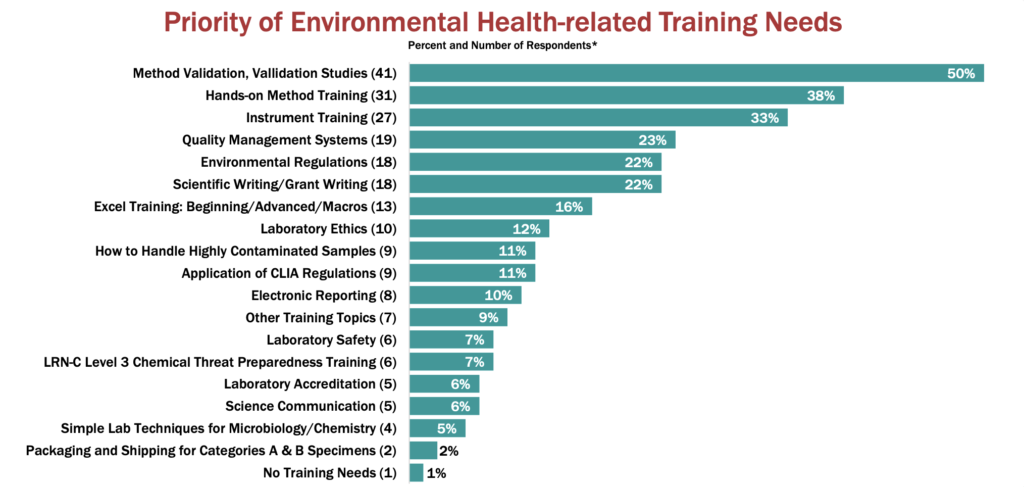
Source: APHL (2023), Environmental Health Training Needs Assessment Summary Report.
In a parallel 2023-2024 cycle, APHL conducted a broader Training Needs Assessment for Public Health Laboratory Essentials. Completed by 307 staff across various roles, the survey highlighted quality systems, continuous improvement, regulatory readiness and laboratory safety as top priorities (APHL, 2024). This suggests that organisations are increasingly using TNA to align training with regulatory and quality systems rather than simply technical skills or soft skills development.
A global benchmarking study of compliance learning in the life sciences industry, including data from users of ComplianceWire, revealed that training-related findings remain one of the most common causes for audit non-conformances as in-person audits resume (Lee and Wiklund, 2023). This underscores the fact that even when training programmes exist, poor documentation, lack of role-based assignment or lack of competence verification result in audit failures and regulatory risk.
Collectively, these studies demonstrate a clear shift. Training Needs Analysis is becoming a core element of audit readiness, especially in sectors where regulation, safety or quality standards are non-negotiable.
The True Cost of an Incomplete TNA
When an organisation neglects a comprehensive Training Needs Analysis, consequences accumulate quietly. Tasks get assigned to individuals based on experience or convenience rather than documented authorisation. Training may occur without proper records, or evidence may rely solely on attendance sheets. Contractors and temporary staff often fall outside the standard system entirely. Competence decays without notice. Compliance teams rely on memory and manual tracking rather than structured documentation.
Such conditions are manageable during normal operations until an audit or inspection challenges them. A single sampled non-conformance, such as a missing certificate, an expired qualification or an untrained operator, can lead auditors to question the rigour of the entire system. The result can be reputational damage, corrective actions, regulatory sanctions or business disruption.
Moreover, the risk is not limited to compliance. Poorly trained or undocumented staff introduce safety hazards, quality variability and an increased chance of human error. The lack of traceability removes accountability and impedes effective corrective action.
Instead of letting these risks accumulate, organisations must treat TNA as a dynamic risk management tool and not a one-off administrative task.
👉 Suggested Reading: Why Corporate Training Fails: The Hidden Gaps Organisations Overlook. A direct look at how training programmes break down in real organisations and why competence, not attendance, is what auditors test.
A Compliance Backwards Method for Training Needs Analysis
To create a robust, defensible Training Needs Analysis, organisations should work backwards from regulatory and compliance requirements rather than from internally convenient job titles or development wishes.
The first step is to map all applicable regulations, standards and internal procedures that impose competence, training or authorisation requirements. This includes safety regulations, quality standards, certification codes, contractual obligations and internal SOPs. Once this baseline is clear, you identify critical tasks and the exact roles, including contractors, temporary staff and site-specific staff, performing them.
With roles and tasks mapped, the next step is to assess actual training and competence status. Importantly, this assessment should distinguish between attendance and genuine competence, for example, through practical assessments, sign-offs offs or on-the-job verification.
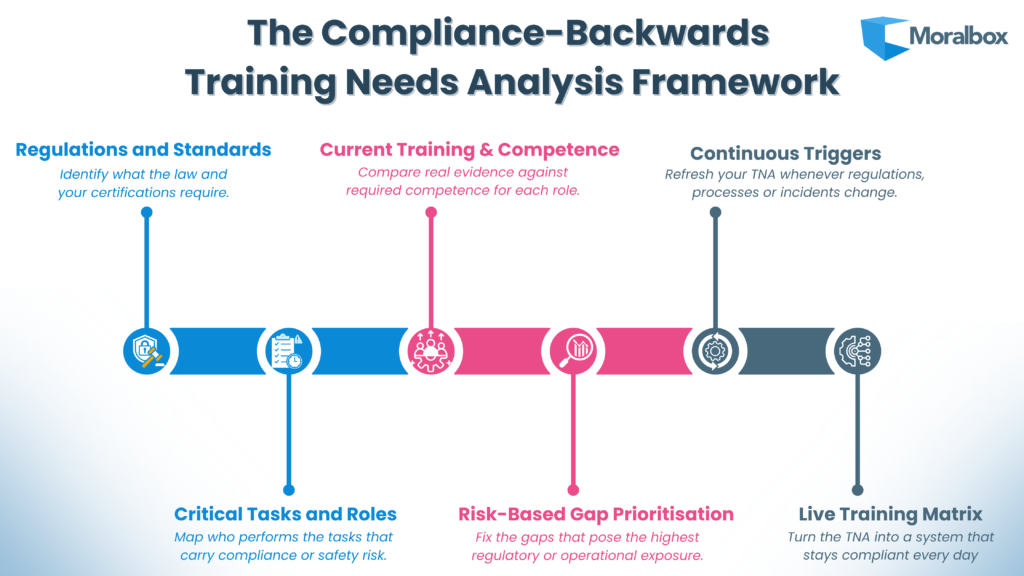
Following this, gaps must be prioritised based on regulatory risk, safety impact, operational criticality and likelihood of task execution. You do not treat all gaps equally. Critical tasks that are carried out often or autonomously must be resolved first. Less critical or infrequent tasks can be scheduled for regular training cycles.
Finally, because organisations evolve with new processes, hires, contractors, regulatory updates or incidents, the TNA should not remain static. Instead, define triggers for review. Any change in regulation, introduction of new equipment or processes, audit findings or incidents should prompt a fresh TNA cycle.
This compliance backwards approach establishes a clear and defensible link between what regulations require and what your organisation executes. It leaves little room for doubt in an audit.
Here is a systematically curated TNA template designed to help you apply this framework in your own organisation. Download it to map requirements, assess gaps and record evidence correctly.
Why a Live Training Matrix Determines Whether TNA Succeeds or Fails
Even a well-structured Training Needs Analysis does not guarantee compliance if it remains a static document. Organisations often complete a TNA report and file it away. Over time, as personnel change, processes evolve, and training expires, the system decays.
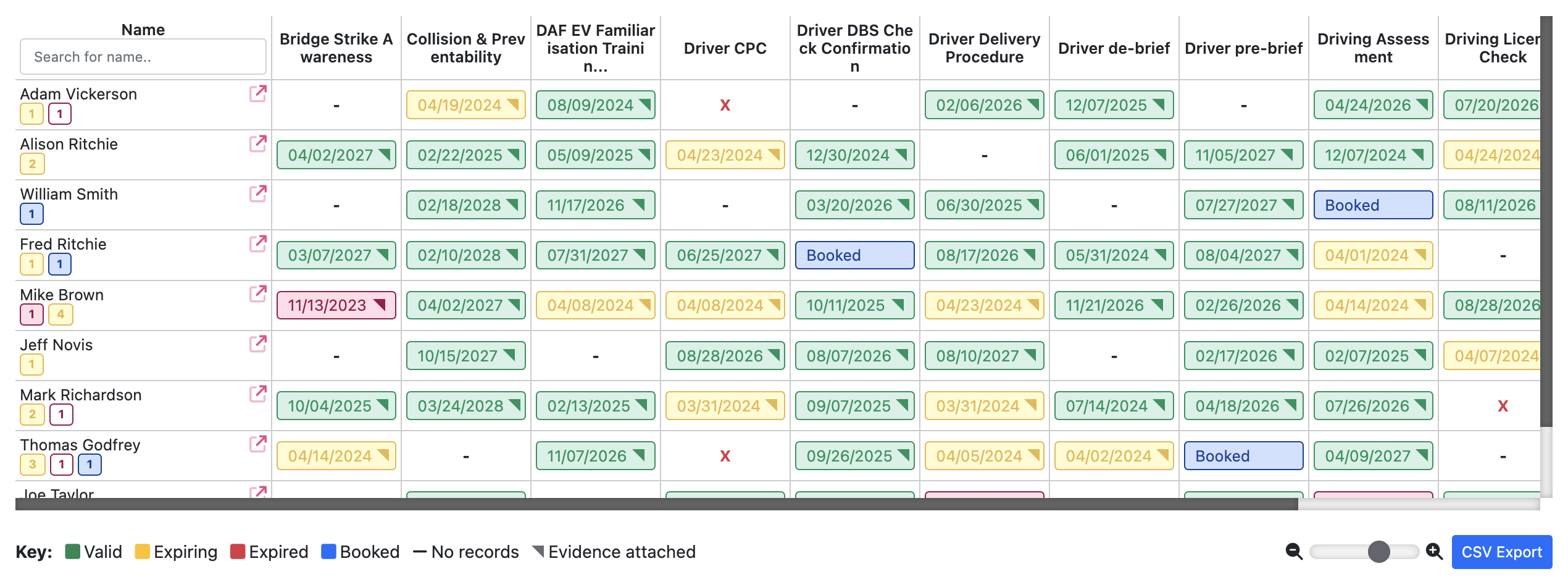
In practice, spreadsheets are prone to errors and lack scalability. Manual updates are inconsistent, reminders fail, and role changes or site transfers are often not recorded promptly. Certification experiences go unnoticed. Temporary or contractor staff often remain untracked.
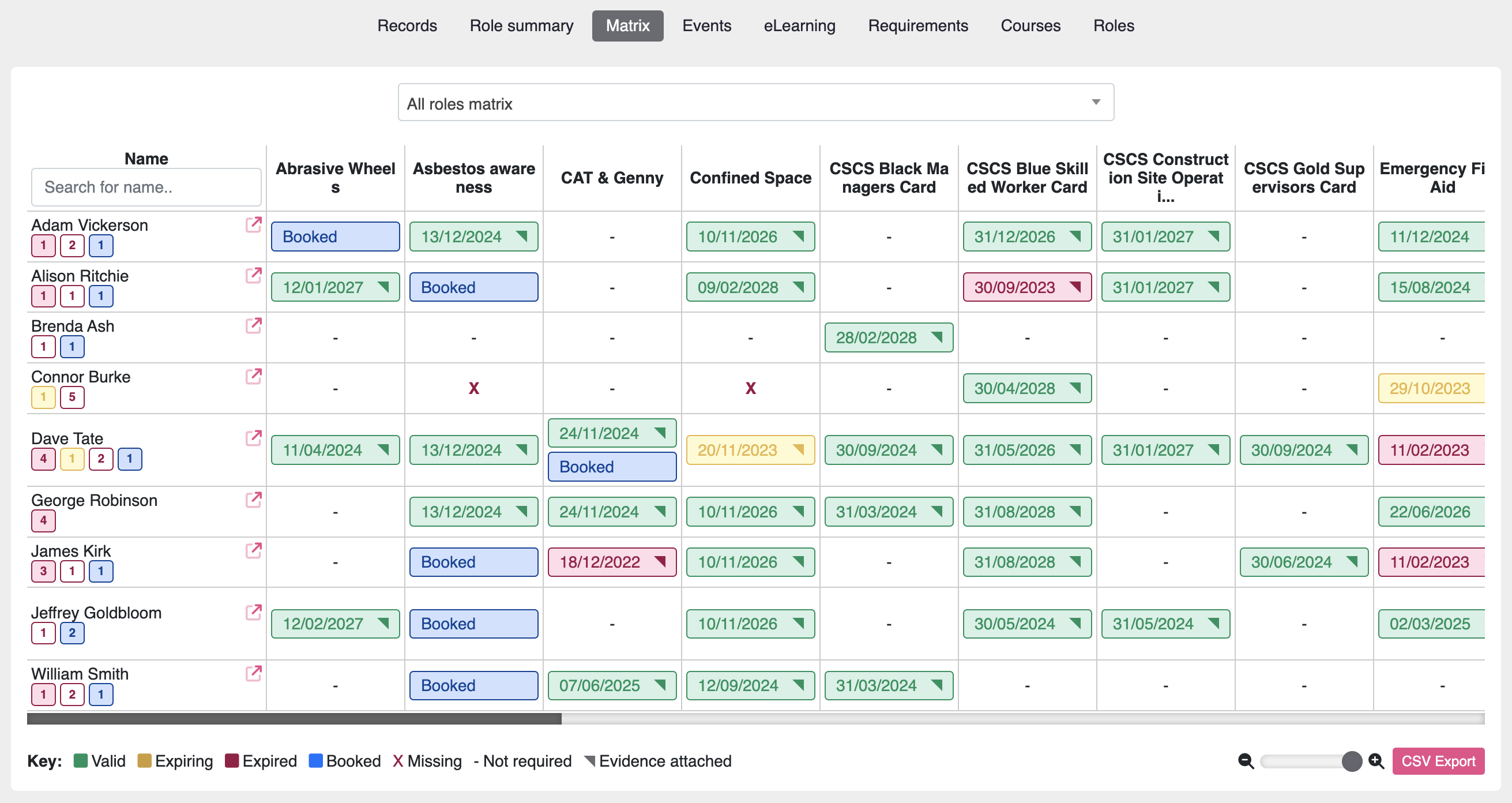
A live, digital training matrix is the only reliable way to prevent this slow drift. Such a system maintains a dynamic record of each person’s role, required training, competence evidence, certification expiry dates and recertification schedules. As roles change or new personnel join, the system updates automatically. Alerts for upcoming expiries or overdue training trigger action proactively.
With a live matrix, compliance teams gain real-time visibility into gaps. Frontline managers can see their teams’ competence at a glance rather than relying on memory. When auditors request training records, reports can be generated instantly, clearly, cleanly and defensibly.
In short, the difference between a good TNA and a truly effective one is not the analytical process itself. It is how that process is operationalised and maintained.
👉 Suggested Reading: Training Matrix vs Spreadsheets: Which One Actually Keeps You Compliant?
A clear breakdown of why spreadsheets fail under audit pressure and how a live training matrix prevents unexpected non-conformances.
How a Platform Like Moralbox Converts TNA into a Daily Compliance Control
Once you have defined training requirements, roles and competence needs, the next challenge is maintaining that clarity and compliance every day. A platform such as Moralbox can transform your TNA from a one-time exercise into a living, automated compliance control.
Moralbox can digitise your entire training matrix, including roles, tasks, required courses, competence assessments, renewal cycles and evidence records. As employees join, change roles or move between sites, the system automatically assigns the training relevant to their new responsibilities. Recertification reminders, expiry tracking and automatic alerts ensure that no requirement slips through the cracks. Competence evidence, not just attendance, can be logged, managed and retrieved.
When an auditor requests proof that specific individuals are authorised for a task or trained to a certain standard, Moralbox can generate real-time reports filtered by task, role or site. Because the records are centrally stored, properly time-stamped, role-linked and evidence-supported, the organisation can respond immediately with confidence.
With this approach, TNA becomes more than a risk mitigation exercise. It becomes a proactive control that keeps competence, compliance and readiness continuously rather than occasionally.
A Final Reality Check for Audit Readiness
Before concluding, consider these questions carefully. Can you trace every training requirement back to an applicable regulation, standard or internal procedure? Can you map which tasks are critical, who performs them and what evidence exists of their competence? Are contractors, temporary staff and site-specific personnel included under the same system? Do you log competence assessments as well as attendance? Do you have a process and triggers to refresh your TNA whenever circumstances change? And last, could you realistically generate a complete and accurate training and competence report for any sample chosen by an auditor in under ten minutes?
If you hesitate at any of these points, your TNA may not be as audit-ready as you believe.
Conclusion: Training Needs Analysis as a Strategic Compliance Control
As audits become more stringent and regulators demand greater accountability, organisations must evolve their approach to Training Needs Analysis. Recent evidence from public health laboratories and life sciences organisations demonstrates that compliance depends not on occasional training efforts but on continuous, risk-based and documented competence management.
A robust, compliance backwards TNA, combined with a live, digital training matrix, transforms training from a reactive task into a proactive control. With this approach, organisations move from scramble and risk to discipline and readiness. They move from uncertainty to confidence.
FAQs
What is the main purpose of a Training Needs Analysis in compliance?
A Training Needs Analysis ensures that every employee performing a regulated or safety-critical task is trained and competent in accordance with legal, industry and internal standards. It protects the organisation from audit findings by linking training directly to regulatory requirements and operational risk.
How often should a Training Needs Analysis be updated?
A TNA should be refreshed at least annually, but it must also be updated whenever regulations change, new equipment or processes are introduced, responsibilities shift, or incidents or audit findings reveal new risks. Continuous updating prevents unexpected non-conformances.
Is a TNA mandatory for audits and certifications?
Many regulated frameworks expect or implicitly require a documented TNA. Standards such as ISO 9001, ISO 45001, and food safety schemes like SQF and BRCGS require organisations to define competence requirements, maintain training records and demonstrate role-based training logic. A TNA is the mechanism that proves this during audits.
References
Association of Public Health Laboratories (APHL). 2023. 2023 Environmental Health Training Needs Assessment Summary Report. APHL. Available at: https://www.aphl.org/aboutAPHL/publications/Documents/QSA-2023-EH-TNA.pdf.
Association of Public Health Laboratories (APHL). 2024. 2024 Public Health Laboratory Essentials Training Needs Assessment Summary Report. APHL. Available at: https://www.aphl.org/aboutAPHL/publications/Documents/QSA-2024-PHL-Essentials-TNA.pdf.
Lee, M.D. and Wiklund, M. (2023) ‘ComplianceWire ® 2023: Compliance Learning Benchmarking Study’. Available at: https://doi.org/10.13140/rg.2.2.20763.64800.

Ananya is a Marketing Executive at Moralbox, passionate about creating content that connects learning with business impact.